Amateur Radio
Transceivers
Although most amateur operators simply buy their transceivers, the home-brew culture continues to thrive.
Perhaps the simplest kit to get started is the 40-meter Pixie kit. The original Pixie design operated in a narrow region around 7.023 MHz, which is in the region of the 40-meter band reserved for Extra-class operators in the United States. Newer versions provide an option to use crystals in the General-class region of the band.
Antennas
Antennas are a vast subject with many avenues for experimentation.
-
An isotropic antenna is a type of antenna that, if it could actually be built, would radiate identically in all directions. The theoretical properties of isotropic antennas are used as a point of reference for comparison to other antenna types.
-
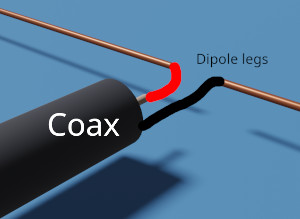
The half-wave dipole is a well-understood antenna design with a radiation pattern that looks like a torus or "donut". Like isotropic antennas, half-wave dipoles are commonly used as the basis for comparison with other antennas.
-
A log-periodic dipole array connects several dipole antennas as elements of one large antenna. With the correct sizing and spacing of each element, the array can act as a single antenna having very wide bandwidth.
-
A quarter-wave monopole or ground plane antenna is like a dipole, except the Earth itself (or an artificial "ground plane") acts as one of the dipole elements.
-
Full-wave loop
-
A magnetic loop antenna can be much smaller than a full-wave loop. These antennas include a high-voltage capacitor that makes the antenna resonant at a frequency lower than would be expected by its size. The drawback is that magnetic loops are only resonant within an extremely narrow range of frequencies. Typically, a variable capacitor is used because it makes precise tuning possible.
-
A Yagi-Uda (or just Yagi) antenna looks similar to a log-periodic antenna at first glance, but the elements combine to increase the antenna's directionality and gain instead of increasing the bandwidth as with the log-periodic antenna.
-
A quad antenna is similar to a Yagi, but each "element" is itself a loop.
Morse code
Morse code is no longer required for licensing in many places, including the United States. However, that doesn't stop thousands of operators from using and enjoying this classic mode of communication.
Digital modes
Most digital modes are valued for their ability to make contacts under extremely suboptimal conditions—low power, high noise, interference, reflections, you name it.
-
Modes based on Phase Shift Keying (PSK)
-
PSK31 transmits data at 31.25 symbols per second, or approximately 4 bytes per second for binary data. A variant called QPSK can encode base-4 data instead of binary. In practice this extra data is used for error correction instead of increasing the communications speed.
-
PSK63 transmit data at 62.5 symbols per second. A variant called PSK63F transmits at half the speed but includes forward error correction.
20 meters: Prefer using PSK63 at frequencies just above the PSK31 area, from 14.0725 MHz up to the RTTY area at 14.080 MHz. Upper sideband.
Other bands: Try to stay within a window of 2.5 KHz that begins 2.5 KHz above the PSK31 area for that band. Upper or lower sideband, as appropriate
PSK31 and PSK63 modes can be used in fldigi.
PSK31 may also be used in LinPsk.
-
-
Modes based on Frequency Shift Keying (FSK)
-
RTTY is perhaps the first digital mode (outside of Morse code) to gain widespread adoption. It remains in use today, although newer protocols make more efficient use of the spectrum.
- WSPR
- APCO P25
-
-
Modes based on Multiple Frequency Shift Keying (MFSK)
- FT8
- FT4
- JT65
Software-defined radio
Software-defined radio, or SDR, is an emerging technology where certain parts of a radio are implemented in software running on a computer instead of using purpose-built hardware.
SDRs tend to be more flexible and physically less complex than analog radios in many ways—except, of course, for the integrated circuits (mainly the ADC/DAC and FPGA chips), which are internally very complex.
Notable hardware:
RTL-SDR is a common name for SDR devices based on the Realtek RTL2832U chip that was originally found in inexpensive USB TV tuner dongles. RTL-SDR dongles are a cheap and simple way to get started with SDR receiving, but not for transmitting.
HackRF One is an SDR transceiver with an open hardware design. It is capable of both transmitting and receiving across a very wide frequency range from 1 MHz up to 6 GHz.
ADALM-PLUTO (PlutoSDR) is an "active learning module" SDR transceiver from Analog Devices. It operates in a range from 325 MHz up to 3.8 GHz.
LimeSDR is another "hackable" open source SDR transceiver. This one operates from 100 kHz up to 3.8 GHz.
Notable software:
-
GNU Radio, with its graphical "Companion" software, is like a visual programming language for assembling signal processing pipelines.
-
SDR# (pronounced "SDR sharp") was originally open source but is now developed and released under a proprietary license. The "sharp" is a nod to the C# programming language and the .NET platform on which it runs. SDR# is extensible with plugins, and a Community Package is available with a large number of plugins already included.
-
Gqrx SDR is free/open source software for use with several SDR devices. It uses libraries from the GNU Radio project (mentioned above) and presents a GUI that is fairly easy for beginners to use.